

Golf balls have dimples because a rough ball flies farther than a smooth one. Roughness makes the thin layer of air on the ball turbulent, so it clings farther around the back, the wake narrows, and drag drops. Dimples do not create backspin. Spin is set at impact, mainly by the club's loft.
A smooth ball looks faster. Everything we know about moving through air says the sleek thing wins, which is why a dimpled golf ball is one of the few objects in sport whose design openly contradicts intuition.
It flies farther because it is rough. That is not a quirk, it is the point, and the reason is worth understanding properly, partly because it is interesting and partly because the usual explanation gets it wrong.
Do dimples make a golf ball go farther?
Yes. Here is the mechanism.
As a ball moves, a very thin layer of air clings to its surface and travels with it. What happens to that layer determines almost everything about the ball's flight.
On a smooth sphere, that layer separates from the surface early. It peels away before it gets around the back. Behind the ball sits a wide pocket of low-pressure, churning air. That wake is drag, and a wide wake is a lot of drag.
Roughen the surface and you change the character of that clinging layer. It becomes turbulent, which sounds worse and is in fact better: a turbulent layer has more energy and clings farther around the curve before it lets go. The separation point moves rearward. The wake narrows. Drag drops.
NASA's own explanation of sphere drag describes this directly: in the appropriate flow regime, surface roughness can reduce a sphere's drag by promoting that boundary-layer transition.
So the ball is not slipping through the air more cleanly. It is deliberately making the air near its surface messier, in order to leave a smaller mess behind it.
Do dimples create backspin?
No, and this is the most common error in writing about golf balls.
Dimples work on the ball during flight. They manage drag, and they affect how the air interacts with a spinning surface. But the spin itself is created at impact, set mainly by the loft the club presents and the direction it is moving, in about half a thousandth of a second.
Two different physics problems, in two different moments. One happens on the clubface, one happens over the next several seconds in the air. Any sentence of the form "dimples put backspin on the ball" has welded them together.
Worth being precise about, because the muddle makes the real explanation harder to find.
What came before the dimpled golf ball?
Three eras, and the honest version has more uncertainty in it than you usually get.
The featherie. A stitched leather case packed tight with feathers. Where and when it was developed is genuinely not established, so any confident date is someone choosing a story. Specialist golf history explicitly treats featherie origins as uncertain, and challenges the evidence for the wooden balls that often get placed before them.
The gutty. Gutta-percha, a natural latex that softens with heat and can be formed, entering the historical transition away from featheries in the late 1840s. A cheaper, more consistent object, and it brought an accident with it.
Golfers noticed that a gutty which had been nicked and scuffed by play flew better than a fresh smooth one. That is a remarkable thing to have observed without instruments, and it is the practical origin of everything that follows. The ball told them, and they listened.
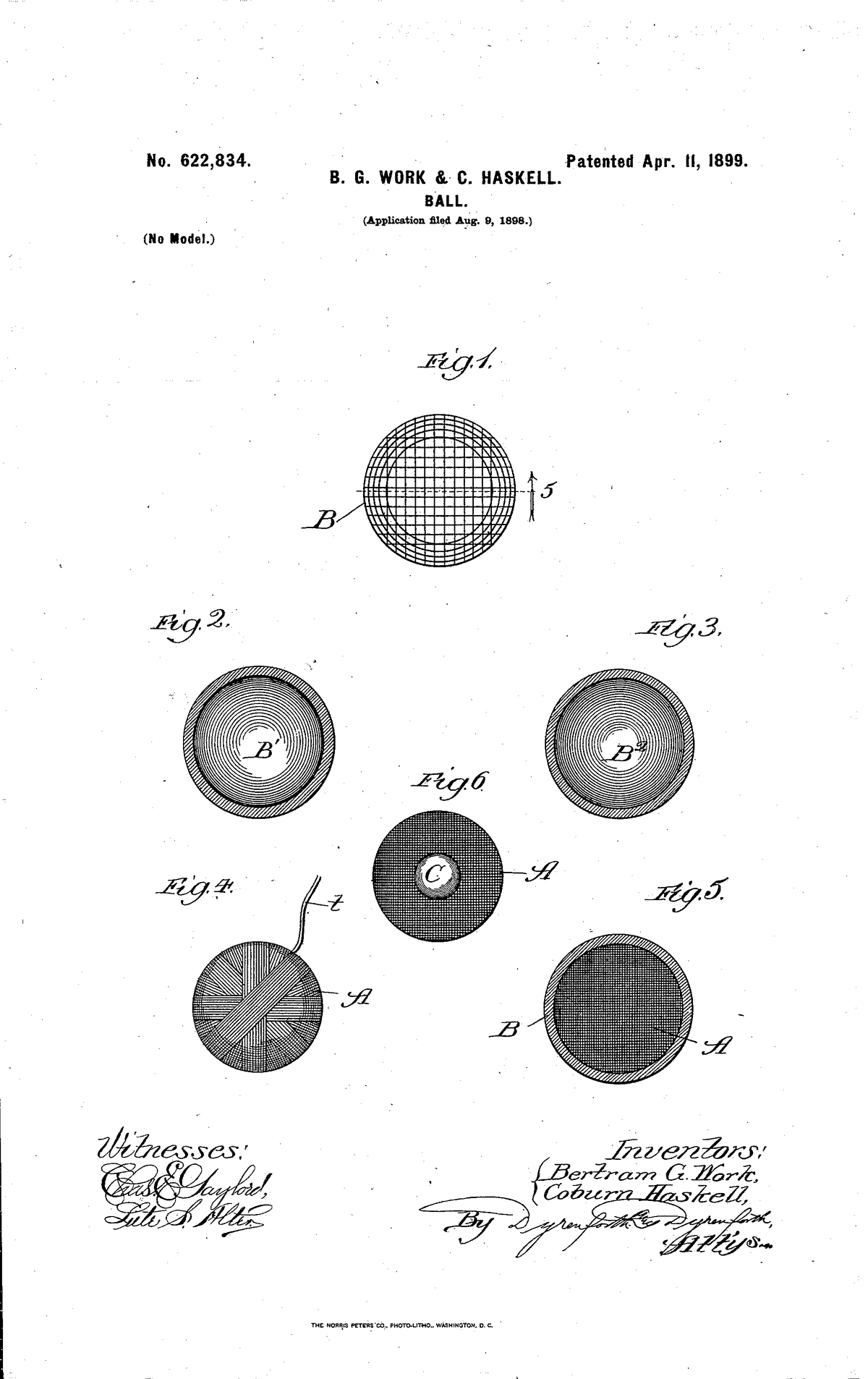
The wound ball. Where the modern ball begins. United States patent 622,834 names Bertram G. Work and Coburn Haskell. It was filed on Aug. 9, 1898 and the patent is dated April 11, 1899, and it describes a core of rubber thread wound under tension beneath an outer covering.
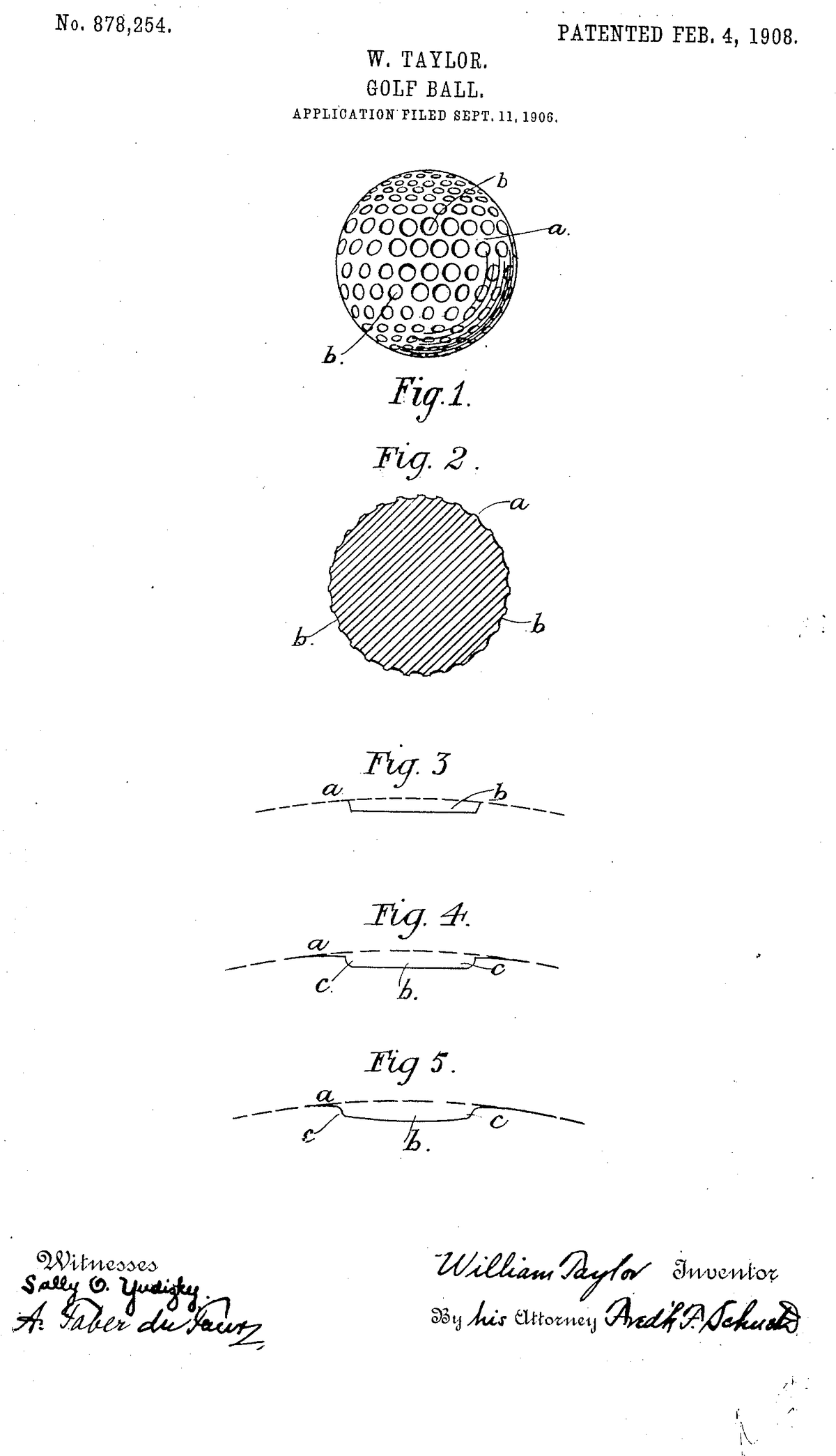
Then the surface became deliberate rather than accidental. A 1908 United States patent, number 878,254, in the name of William Taylor, an English engineer from Leicester, describes isolated cavities set into the ball's surface. Scuffs became specification.
Two points of care about those patents, because they are commonly overread. A filing and a grant are different events, months or years apart. And a patent describes one documented design. It does not prove its holder was first to the underlying idea, or that the advantages it claims were independently tested. Inventions accumulate; patents are just the parts of that accumulation that got written down.
Why did a longer-flying ball become a problem?
Because an improved object changes the questions a sport has to ask about itself.
Every gain in the ball was a gain for everyone, which sounds harmless. But golf is played on fixed ground. A course is a set of distances, and hazards sit where someone decided they should sit. Make the ball travel farther and you have not improved the golfer. You have quietly moved every bunker.
The response was to lengthen courses, which costs land, water, money and time, and which does nothing for the player who was not hitting it past the bunkers anyway.
None of this is an argument about your own bag. The distance question belongs to elite play and course architecture. The practical questions for most golfers are smaller, and we have taken those up separately in a post on buying used golf clubs.
This is the tension the governing bodies' Distance Insights project was set up to examine, and their concerns are an institutional judgment worth attributing to them rather than stating as settled fact. Where it lands is live, contested and still moving, which is why this post stops at the question rather than predicting an answer.
That is the real shape of the golf ball's history. Not a straight line of improvement, but a long argument about what a sport should reward. That argument has run for over a century, conducted through a small white object that most people never think about.
Quick answers
Why do golf balls have dimples?
Because a rough ball flies farther than a smooth one. Roughening the surface makes the thin layer of air on the ball turbulent, so it clings farther around the curve before it lets go. The wake narrows and drag drops.
What was the Haskell golf ball?
United States patent 622,834 names Bertram G. Work and Coburn Haskell. It was filed on Aug. 9, 1898, dated April 11, 1899, and describes a core of rubber thread wound under tension beneath an outer covering.
When was the featherie golf ball developed?
The precise place and time are not established. Gutta-percha balls entered the transition away from featheries in the late 1840s.
Do dimples create backspin?
No. Spin is set at impact, while the ball is on the face for about half a millisecond, mainly by the loft the club presents relative to the direction it is moving. Dimples work on the ball during flight, managing drag.
Sources and further reading
- NASA Glenn Research Center, Drag of a Sphere: the boundary-layer and drag explanation, including the effect of surface roughness.
- US Patent 622,834, Ball (Bertram G. Work and Coburn Haskell): the wound rubber-thread core, with its filing and grant dates.
- US Patent 878,254, Golf-ball (William Taylor): the 1908 patent describing isolated surface cavities.
- Scottish Golf History, The Golf Ball from Hairy to Haskell: specialist history, explicit about what is uncertain, and the source for golfers noticing that a ball performed better once it had nicks and blemishes.
- USGA, What Happens in the Collision Course Between Club and Ball? (May 2025): the contact time, about 500 microseconds, or half a millisecond.
- Trackman, What is Spin Loft? (Sept. 23, 2024): spin loft, the angle between the club's direction of travel and where the face points, as the key to controlling spin rate.
- USGA and R&A, Distance Insights: the governing bodies' project on distance and its implications.
Infinite Fairway sells used and vintage golf clubs and vintage logo golf balls, with photos of the exact item, through our official eBay store.
Good old clubs still play. Infinite Fairway. Go Golf.
